Why Vibe Coding is Basically Playing with the Timebomb
Vibe coding means shipping AI code you don't understand. See how it detonates in debugging, security and scaling, and how to use AI coding tools right.
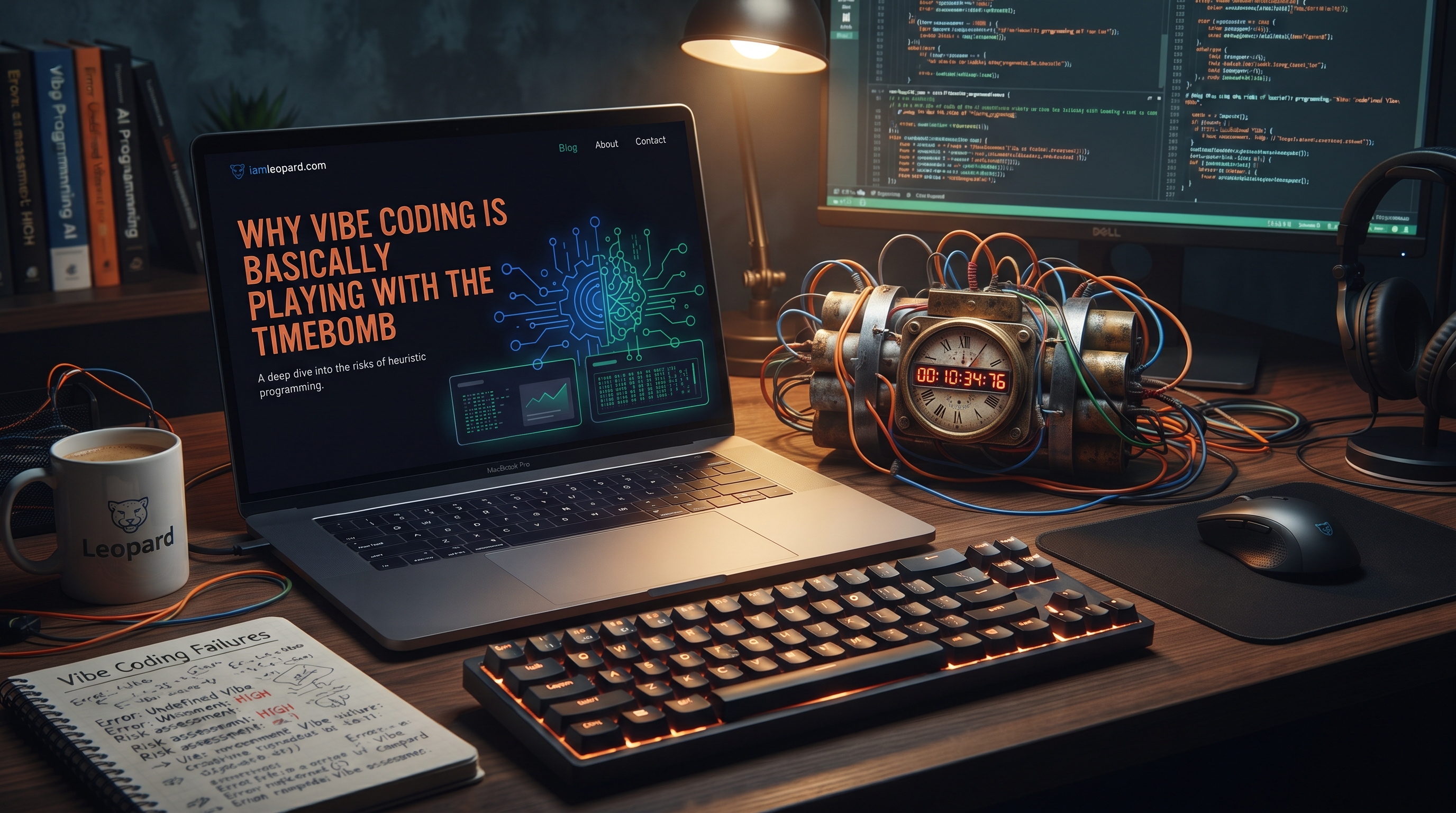
What is Vibe Coding and Why It's a Problem
We live in a fascinating time for software development. AI coding tools promise to supercharge our productivity. But there’s a dangerous trend emerging: vibe coding. This is when you let an AI coding assistant generate substantial chunks of code, then you accept and ship that code without truly understanding its inner workings. It feels fast. It feels productive. In reality, you are playing with a timebomb.
The core issue is a loophole. You are building something without the fundamental knowledge of how it works. You're trusting an opaque process to deliver production-ready solutions, skipping the crucial step of internalizing the logic, the edge cases, and the potential pitfalls. I see this happening more often than I like, and it sets teams up for serious pain down the road.
The Illusion of Effortless Productivity
The appeal of vibe coding is obvious. Tools like the Codex Chrome extension or even a Kiro IDE can spit out boilerplate or complex algorithms in seconds. Need a database migration script? An API endpoint handler? Just prompt, copy, and paste. It feels like magic. This instant gratification is a powerful drug for developers facing tight deadlines or complex problems. Studies show that up to 70% of developers now use AI coding assistants for daily tasks.
It’s tempting to think this speed is pure gain. You're knocking out features, clearing tickets, and moving fast. On the surface, it looks like peak efficiency. But this perceived productivity often masks a deeper, growing technical debt. The code might work for the happy path, but what happens when it hits a snag?
Where the Timebomb Detonates
The problem with not understanding your code isn't theoretical. It manifests in very real, painful ways when your system goes live. This is where the timebomb I am talking about truly detonates.
Debugging You Cannot Do
When an AI generated a block of code, and that code breaks in production, how do you debug it if you never understood it in the first place? You stare at lines of code you accepted, but didn't write, and definitely didn't internalize. It's like trying to fix a complex engine when you only know how to press the start button. Debugging often consumes up to 50% of a developer's time on a project. If you lack the foundational knowledge of the logic, that 50% can easily become 100% frustration, leading to missed deadlines and escalating costs. You can't just ask the AI why its own code broke; it needs a human expert.
Security You Cannot Audit
Security is not a feature you bolt on at the end. It must be designed in. If you're vibe coding, you're outsourcing security considerations to an AI that doesn't understand your specific threat model or business context. An estimated 85% of security breaches involve vulnerabilities in application code. An AI might generate code that seems functional but has subtle security flaws, like SQL injection vulnerabilities, improper input validation, or insecure deserialization. You won't spot these if you don't understand the underlying patterns and risks. Auditing AI-generated code requires even more human expertise, not less.
Scaling You Did Not Design For
Web applications, backends, and mobile apps need to handle growth. Scaling is a critical concern for any real business. If your AI-generated code wasn't written with scalability in mind, or if you don't understand the performance implications of its choices, you're in trouble. A simple API endpoint might work fine for 10 users, but crash and burn for 10,000. For instance, the choice between Java vs Go for a backend depends heavily on the scaling needs and architectural patterns. If you don't understand the performance characteristics and concurrency models of your chosen stack, you're simply guessing, and guessing is not engineering.
Shipping code you don't fully grasp is a fast track to technical debt, creating systems that are brittle, insecure, and ultimately unmaintainable.
And that technical debt can be crippling. Studies show that technical debt costs organizations over 40% of their development budget annually. This is a direct result of shortcuts and a lack of deep understanding when the code was first written.
Code You Do Not Own in Your Head
When you truly understand a codebase, you own it in your head. You know its quirks, its strengths, and its weaknesses. This mental model is vital for effective maintenance, feature expansion, and team collaboration. Vibe coding strips this ownership away. Your mental model becomes fragmented, relying on an external black box. When a critical bug hits, or a new requirement comes in, you're starting from scratch, trying to reverse-engineer code you supposedly wrote. This makes you less of an engineer and more of a code babysitter.
How a Real Engineer Uses AI as a Power Tool
This isn't an anti-AI rant. AI coding tools are incredible power tools when used correctly. The key is to use them as a co-pilot, not a pilot. Here’s how a real engineer integrates AI without outsourcing their understanding:
AI as a Learning Accelerator
I use AI to explore unfamiliar APIs, understand new patterns, or see different implementations of a concept. It's a fantastic teaching assistant. I'll ask it to generate code, but then I spend time dissecting it, understanding every line, and asking why it made certain choices. This builds my mental model, rather than replacing it. When I am weighing something like Java vs Go for a new service, I let an AI coding assistant prototype both, then I read every line before I trust either.
Setting Up an Agent Harness for Validation
When I use AI to generate non-trivial code, I often set up an agent harness around it. This means writing my own tests, checks, and validation logic that specifically targets the AI's output. I treat the AI's code as a suggestion, not a final solution. I'm verifying its work, ensuring it meets my standards for security, performance, and correctness. This is where my engineering expertise becomes even more valuable, not less.
The Human in the Loop is Non-Negotiable
Ultimately, the human engineer is responsible for the code that ships. We are the ones who understand the business requirements, the user impact, and the long-term maintainability. AI can automate tasks, but it cannot automate judgment, critical thinking, or ethical considerations. I use AI to accelerate my work, but I never let it replace my understanding or my responsibility.
Frequently Asked Questions About AI and Code Quality
Can AI coding tools really write production-ready code?
AI coding tools can generate functional code, but whether it is production-ready depends entirely on human oversight and validation. Without deep understanding and rigorous testing by a human engineer, AI-generated code often carries hidden bugs, security vulnerabilities, or performance issues that are not apparent until runtime.
How can I avoid vibe coding?
Whether the code comes from the Codex Chrome extension, a Kiro IDE session, or any other AI coding assistant, always review it line by line. Understand its logic, test its behavior, and verify its adherence to best practices and security standards. Treat AI as a helpful assistant that provides suggestions, not a replacement for your own engineering expertise. Learning to set up an agent harness is also key.
Does using AI make me a less skilled developer?
No, using AI intelligently can make you a more skilled developer. It frees you from mundane tasks, allowing you to focus on complex problem-solving, architectural design, and deep understanding. The skill shifts from rote memorization to effective prompting, critical evaluation, and integration of AI output.
What are the biggest risks of relying too much on AI for coding?
The biggest risks include accumulating technical debt, introducing hard-to-find bugs, creating security vulnerabilities, and building systems that are difficult to debug, maintain, and scale. Over-reliance can also stunt your own learning and critical thinking skills, leading to a diminished capacity for independent problem solving.
Take Control of Your Codebase
Vibe coding is a shortcut that leads to a longer, more painful road. As engineers, our responsibility is to build reliable, secure, and maintainable systems. AI is an incredible tool that can help us achieve that, but it is not a substitute for our expertise, our understanding, or our ownership of the code.
If you're building web apps, backends, mobile apps, or need expert guidance on AI and machine learning, you want a partner who understands every line of code. You can explore all my services, including dedicated AI and Machine Learning development. Interested in joining a team that values deep understanding? Check out my career page. And if you're ready to discuss your next project, reach out and contact me directly.